GEOTECHNICAL ENGINEERING1
CHELTENHAM
HomeInvestigationCPT (Cone Penetration Test)

CPT Testing in Cheltenham — Fast Stratigraphy with Cone Penetration

Knowledgeable. Thorough. Resourceful.

LEARN MORE

Cheltenham sits at roughly 60 metres above sea level on the lower Cotswold dip slope, where the town centre overlies Charmouth Mudstone and the northern suburbs transition into Inferior Oolite limestone. In our experience, a borehole log alone misses the thin sand lenses and weathered clay bands that control foundation settlement here. Cone Penetration Testing captures those transitions continuously — tip resistance, sleeve friction, and pore pressure every 20 mm — giving you a stratigraphic profile that reads almost like a core but without the sample disturbance. For projects near the River Chelt or in the expanding residential zones around Hester’s Way, this continuous record is what separates a safe foundation depth from a costly underpinning job later.

In Cheltenham's Lias Clay, a CPT trace tells you more about undrained shear strength in two hours than a week of triaxial tests ever could.
Our service areas

Process and scope

The Charmouth Mudstone Formation dominates central Cheltenham — a Lower Lias sequence of dark, fissile clays interbedded with thin limestone bands and occasional pyrite nodules. We routinely encounter undrained shear strengths between 60 and 120 kPa in the upper 5 metres, dropping below 40 kPa where groundwater softens the clay fabric. Our 20-tonne CPT rig pushes a 60-degree apex cone at 2 cm/s, logging qc, fs, and u₂ through these weathered zones to pinpoint exactly where the competent stratum begins. In gravelly head deposits overlying the Oolite on the eastern slopes, we switch to a push-rod configuration with a pre-drilled casing to bypass coarse material and keep the cone advancing without buckling. The raw data feeds directly into soil behaviour type charts after Robertson (1990), letting us classify the material in real time — because on a Cheltenham site with a 48-hour window before the excavator arrives, waiting for lab index tests is not an option.
CPT Testing in Cheltenham — Fast Stratigraphy with Cone Penetration
Technical reference — Cheltenham

Site-specific factors

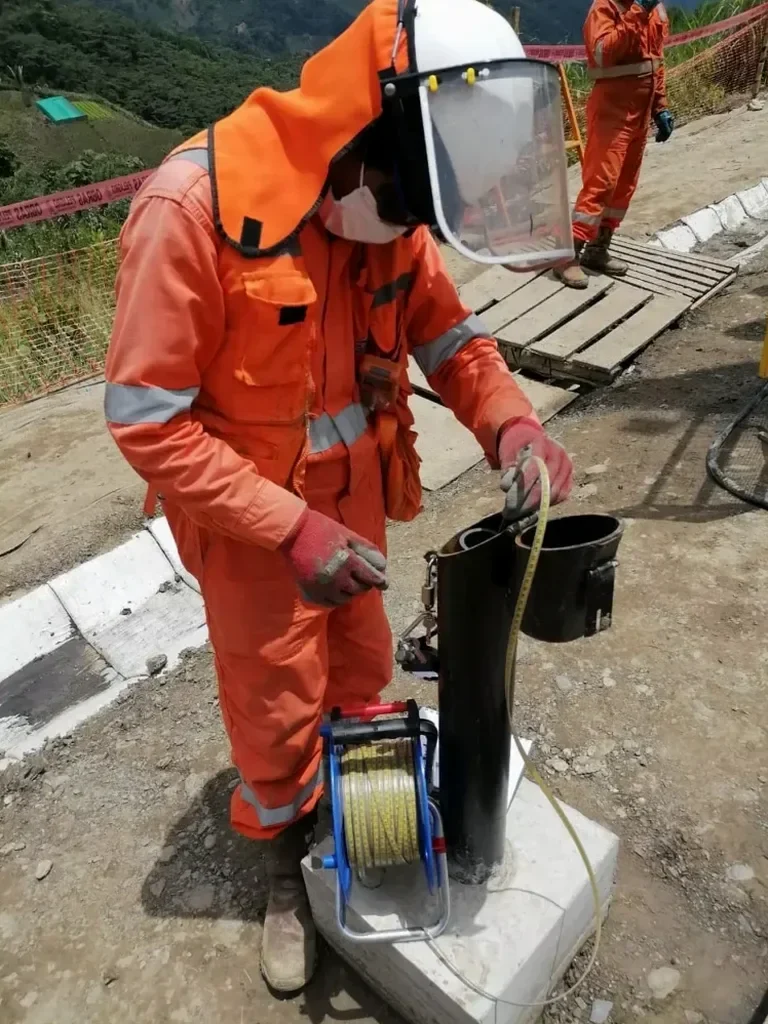
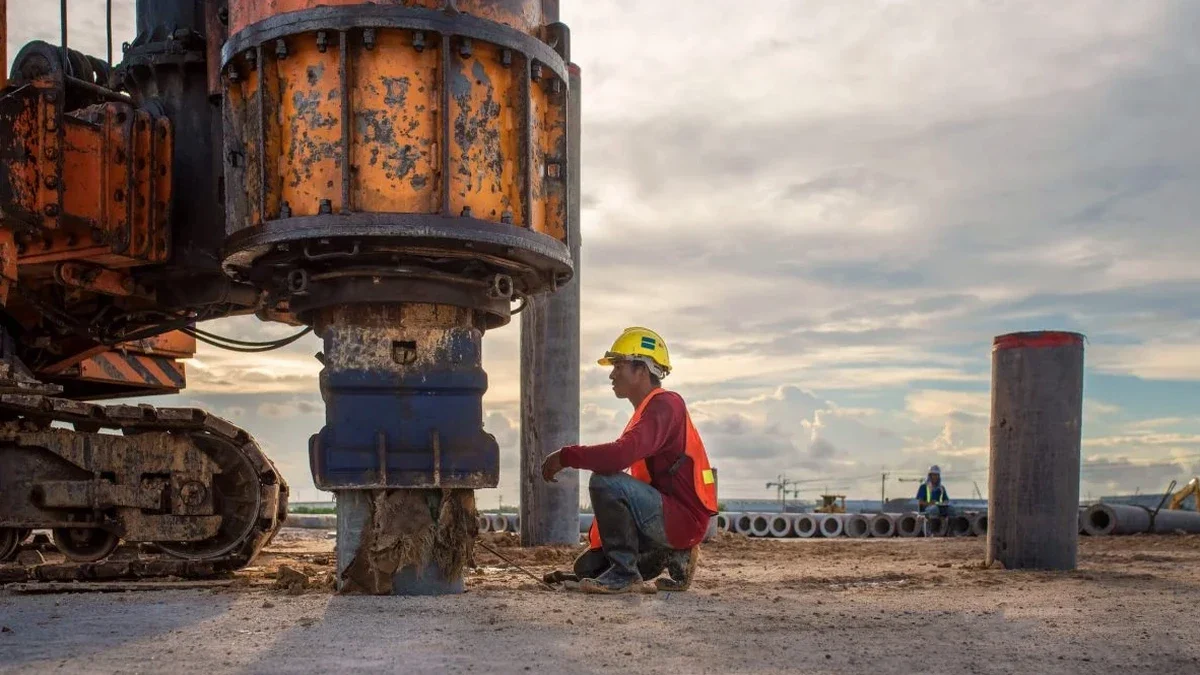
Our rig arrives on a tracked carrier that exerts less ground pressure than a wheeled auger, which matters on Cheltenham's saturated clay sites after a wet winter. The operator sets up over the pre-marked test point, levels the hydraulic rams, and starts the continuous push. Immediately the screen shows tip resistance climbing through the weathered crust, then a sharp drop where the cone enters softened Charmouth Mudstone — that's the undrained shear strength profile building in real time. If pore pressure spikes and dissipates slowly, we flag a low-permeability zone that will complicate drainage design. In one case off Tewkesbury Road, a 1.5-metre gravel lens sitting on weathered Lias showed up as a friction ratio anomaly that a conventional SPT string had completely missed. That lens was the key to designing a shallow pad foundation that avoided deep piling.

Need a geotechnical assessment?

Reply within 24h.

Email: contact@geotechnical-engineering1.com

Video resource

Applicable standards

BS 5930:2015+A1:2020 — Code of practice for ground investigations, BS EN ISO 22476-1:2012 — Geotechnical investigation and testing. Field testing. Electrical cone and piezocone penetration test, Eurocode 7 (BS EN 1997-2:2007) — Ground investigation and testing

Typical values

ParameterTypical value
Cone tip resistance (qc)0–50 MPa (typical Cheltenham clay range 0.8–4 MPa)
Sleeve friction (fs)0–1 MPa, continuous reading every 10 mm
Pore water pressure (u₂)Filter element behind cone shoulder, saturated response < 2 s
Push rate20 mm/s ± 5 mm/s per BS EN ISO 22476-1
Penetration depth capacityUp to 30 m in soft ground, reduced with pre-drilling in gravel
Data acquisitionDigital logging at 20 mm intervals, real-time screen display

Frequently asked questions

How much does a CPT test cost in Cheltenham?

For a single CPT sounding to 15 metres within the Cheltenham urban area, budget between £140 and £230 per metre, depending on access constraints and whether pre-drilling through gravel is needed. A typical two-point residential investigation runs £1,200–£1,600 including mobilisation and a factual report.

How does CPT compare to SPT boreholes in Cheltenham clay?

CPT gives a continuous profile with tip resistance, sleeve friction, and pore pressure measured every 20 mm — no gaps between sampled intervals. SPT recovers a disturbed sample every 1.5 metres and can miss thin soft seams. In Cheltenham's Lias Clay, where 200 mm bands of slickensided material can control slope stability, CPT catches them; SPT often does not.

What depth can a CPT rig reach in Cheltenham ground conditions?

In the Charmouth Mudstone we routinely reach 25–30 metres before refusal, provided the clay is not desiccated at surface. On gravelly head deposits east of town, we pre-drill through the coarse zone and continue to 15–20 metres. Refusal is defined as qc exceeding 50 MPa or rod inclination exceeding 15 degrees.

Is CPT accepted for foundation design under UK building regulations?

Yes. BS EN 1997-2 explicitly recognises CPT as a primary site investigation method. Parameters derived from CPT — undrained shear strength, constrained modulus, friction angle — are directly usable for bearing capacity and settlement calculations in Cheltenham, provided a factual report is signed by a chartered geotechnical engineer.

Location and service area

We serve projects in Cheltenham and surrounding areas.

View larger map