GEOTECHNICAL ENGINEERING1
CHELTENHAM
HomeGround improvementVibrocompaction design

Vibrocompaction Design in Cheltenham: Ground Improvement for Lias Clay and Alluvial Deposits

Knowledgeable. Thorough. Resourceful.

LEARN MORE

The Severn Vale's geology shapes every foundation decision in Cheltenham. Beneath the Regency terraces, the Charmouth Mudstone Formation — part of the Lower Lias — weathers to a stiff, fissured clay that swells seasonally with the Cotswold rainfall. Across the town centre and towards the racecourse, pockets of Cheltenham Sand and Gravel introduce a different challenge: loose granular lenses at shallow depth that compact unpredictably under load. A CPT test across a site near Pittville Park will often show a cone resistance drop from 8 MPa in the clay to below 2 MPa in these gravel seams — exactly the contrast that vibrocompaction design has to reconcile. Our team models the interaction between the Lias formation and these alluvial channels to specify vibrator spacing, frequency, and dwell time that densify the loose zones without remoulding the surrounding clay. We work to BS EN 1997-1:2004, applying Design Approach 1 for ultimate limit state verification, because Cheltenham's mixed stratigraphy demands both strength and serviceability checks that a single partial factor set cannot capture.

Post-treatment CPT in Cheltenham's gravel lenses should show a cone resistance increase of at least 2.5 times the pre-treatment value to confirm the design relative density.
Our service areas

Process and scope

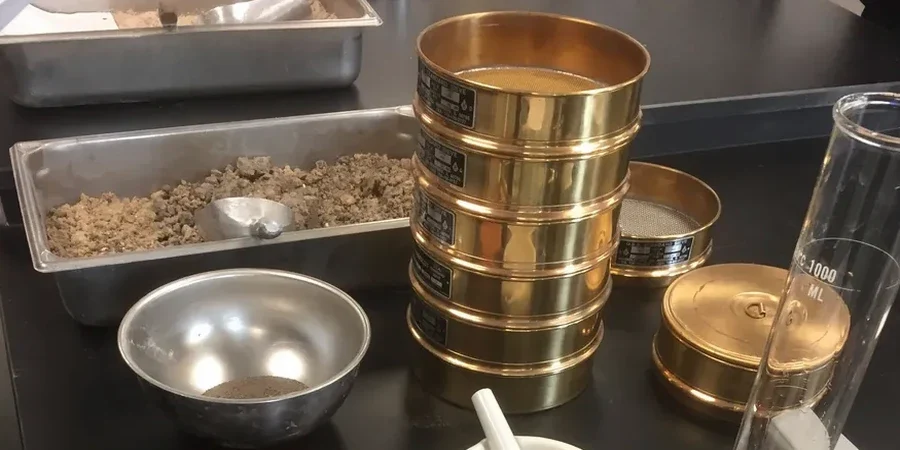
The expansion of Cheltenham's light industrial estates along the A435 corridor has pushed construction onto marginal ground that the Victorians sensibly avoided. Where the Cheltenham Sand exceeds 3.0 metres in thickness, we design a vibrocompaction grid that targets a relative density of at least 70 percent, verified by post-treatment SPT or CPT correlation. The vibrator — typically a V23 or larger unit — penetrates to refusal on the Lias clay bedrock, which here sits between 4 and 9 metres below ground level. We define the compaction point spacing based on the fines content of the granular layer: if the soil has less than 12 percent passing the 75-micron sieve, a triangular grid at 2.4 metre centres usually achieves the specification; above 15 percent fines, we halve the spacing and increase the dwell time to force pore pressure dissipation. The stone columns alternative becomes viable when the gravel is too silty for pure vibrocompaction — a judgment we make after reviewing the particle size distribution from a grain size analysis. Every design package includes a detailed compaction sequence drawing, showing the primary and secondary passes, to prevent the sand lens from densifying at the top while leaving a loose core at depth — a failure mode we have diagnosed on three remedial projects in Cheltenham in the past decade.
Vibrocompaction Design in Cheltenham: Ground Improvement for Lias Clay and Alluvial Deposits
Technical reference — Cheltenham

Site-specific factors

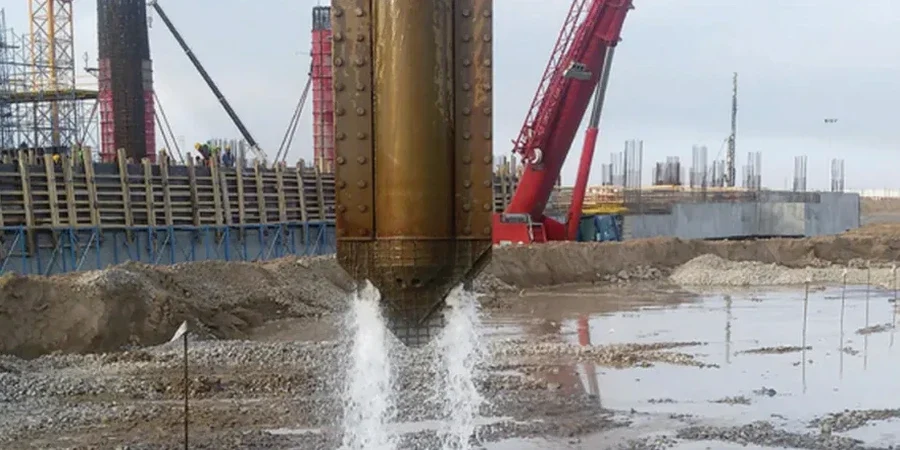
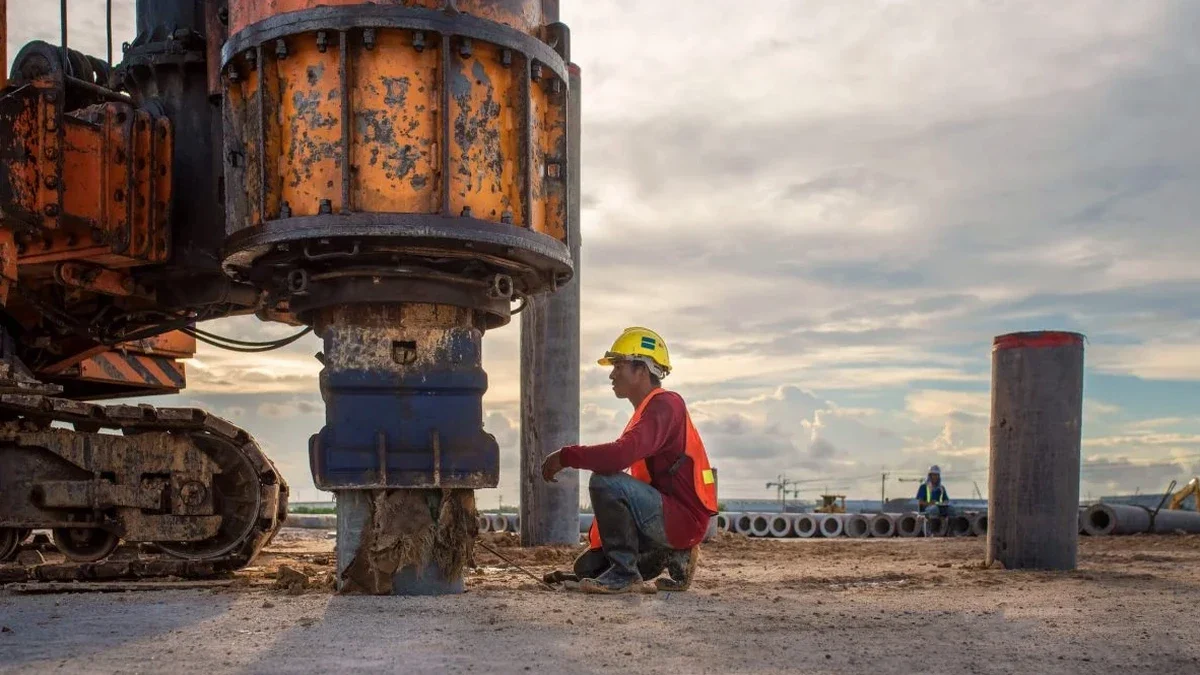
The V23 vibrator we mobilise for Cheltenham sites weighs 22 tonnes and delivers 180 kW of hydraulic power to the oscillating mass. The probe — 320 mm in diameter and 3.5 metres long — generates centrifugal force up to 400 kN at 30 Hz, enough to fluidise the Cheltenham Sand over a radius of 1.8 metres. The main risk during treatment is not undercompaction but overcompaction of thin gravel layers that sit directly atop the Lias clay. When the vibrator punches through a 1.5-metre gravel lens and hits the stiff clay, the energy reflects upward and can dilate the lower portion of the gravel while densifying the top — creating a dense crust over a loose base. We mitigate this by programming a stepwise extraction: the vibrator lifts 300 mm, holds for 15 seconds, then lifts again, allowing the compaction to propagate downward. In Cheltenham's built-up areas, vibration monitoring at adjacent properties is mandatory; we set a peak particle velocity alarm at 5 mm/s for Victorian brick terraces within 15 metres of the compaction point, per BS 5228-2:2009.

Need a geotechnical assessment?

Reply within 24h.

Email: contact@geotechnical-engineering1.com

Video resource

Applicable standards

BS EN 1997-1:2004 (Eurocode 7, Geotechnical design – General rules), BS EN 1997-2:2007 (Ground investigation and testing), BS EN ISO 22476-1:2023 (CPT and CPTU field testing), BS 5930:2015 (Code of practice for ground investigations), BS 5228-2:2009 (Vibration control on construction sites)

Typical values

ParameterTypical value
Target relative density (Dr)≥ 70% (BS EN 1997-2 Annex D correlation)
Typical depth range in Cheltenham3.0 – 9.5 m bgl (to Lias clay refusal)
Vibrator power requirement130 – 180 kW (V23/V32 class)
Compaction point spacing (clean sand)2.0 – 2.8 m triangular grid
Compaction point spacing (silty sand)1.4 – 2.0 m triangular grid
Post-treatment verification methodCPT or SPT (N₁)₆₀ correlation per BS EN ISO 22476
Settlement reduction factorTypically 2.5 – 4.0 for loose Cheltenham Sand

Frequently asked questions

What does vibrocompaction design cost for a site in Cheltenham?

Design fees for vibrocompaction in Cheltenham typically range from £1,160 to £3,840, depending on the site area, number of compaction points, and whether pre-treatment CPT data already exists or needs to be collected. A 500 m² site with existing ground investigation usually falls at the lower end; larger commercial plots requiring a full investigation campaign and multiple verification rounds sit at the upper end.

Is vibrocompaction suitable for the Lias clay areas of Cheltenham?

Vibrocompaction is effective only in granular soils — it cannot densify the Lias clay itself. However, many Cheltenham sites have lenses of Cheltenham Sand and Gravel interbedded with or overlying the clay. We design the treatment to target these granular layers specifically, improving their bearing capacity and reducing differential settlement. If the granular thickness is less than 2.0 metres, stone columns or rigid inclusions may be a better solution.

How long does vibrocompaction take on a typical Cheltenham site?

For a 500 m² area with compaction points on a 2.4-metre grid, the vibrator can complete primary compaction in one to two days. Adding a secondary pass — which we recommend when the fines content exceeds 10 percent — extends the programme to three days total. Mobilisation and demobilisation of the V23 rig add one day at each end.

What verification do you provide after vibrocompaction?

We carry out CPT soundings at a minimum of 10 percent of compaction point locations, plus one sounding in the centroid of each treatment panel. The post-treatment cone resistance is compared against the pre-treatment baseline, and we require a minimum improvement factor of 2.5 to confirm the design relative density. A factual report with all CPT logs and the compliance statement is issued within five working days of testing.
Location and service area

We serve projects in Cheltenham and surrounding areas.

View larger map