GEOTECHNICAL ENGINEERING1
CHELTENHAM
HomeLaboratoryTriaxial test

Triaxial Testing for Geotechnical Design in Cheltenham

Knowledgeable. Thorough. Resourceful.

LEARN MORE

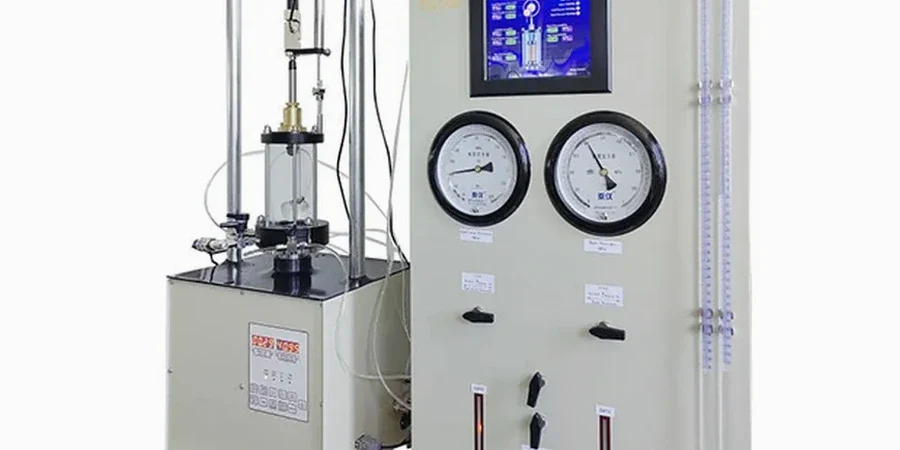
The Lower Lias Clay beneath Cheltenham's Regency terraces demands more than a standard site investigation. A consolidated-undrained triaxial test with pore pressure measurement reveals how this stiff, overconsolidated clay behaves when excavated for basement extensions or loaded by new foundations. The town's position where the Cotswold escarpment meets the Severn Vale means project sites often encounter a weathered transition zone — limestone brash over clay — where the effective stress parameters obtained from a triaxial test become critical for accurate bearing capacity calculations. Without these site-specific figures, designers rely on conservative assumptions that inflate foundation costs. The laboratory's UKAS-accredited triaxial cells apply back pressures to saturate specimens, then shear them at controlled strain rates to match the drainage conditions expected in the field, whether drained for long-term slopes or undrained for rapid construction loading.

The triaxial test gives us c' and φ' directly — parameters no empirical correlation can replicate for Cheltenham's weathered Lias.
Our service areas

Process and scope

Sites on the eastern side of Cheltenham, toward Charlton Kings, often sit on Inferior Oolite limestone with relatively high friction angles. By contrast, the alluvial gravels and clays near the River Chelt in the town centre exhibit lower undrained shear strengths and higher compressibility. A multi-stage triaxial test on a single specimen can define the failure envelope for both materials, saving recovery time when core samples are limited. The test programme is typically paired with atterberg-limits to classify the clay fraction and predict volume change potential, and with spt-drilling to correlate triaxial strength with in-situ penetration resistance across the site. Specimens are trimmed to 100mm or 38mm diameter, compacted or intact, and consolidated to the estimated in-situ stress state before shearing. Pore pressure transducers record the A and B coefficients, essential for calculating effective normal stresses in drained and undrained scenarios alike.
Triaxial Testing for Geotechnical Design in Cheltenham
Technical reference — Cheltenham

Site-specific factors

BS EN 1997-2 (Eurocode 7) requires soil strength parameters to be derived from laboratory tests that replicate field drainage conditions, and this becomes particularly relevant in Cheltenham where groundwater perched above the Lias Clay can soften the weathered surface layers. A drained triaxial test run too fast yields an artificially high friction angle — a dangerous outcome if used to design a permanent retaining wall on a sloping site in Battledown. Conversely, an undrained test on a fissured clay specimen that has not been fully saturated may underestimate the excess pore pressure generated during construction of a deep excavation near the High Street. The laboratory's saturation ramp and B-check procedure, typically achieving a B-value above 0.95 before shear, directly addresses this risk. The resulting Mohr-Coulomb parameters feed directly into limit equilibrium analyses for slope-stability and into finite element models for deep-excavations where the serviceability limit state depends on realistic stiffness degradation with strain.

Need a geotechnical assessment?

Reply within 24h.

Email: contact@geotechnical-engineering1.com

Applicable standards

BS EN ISO 17892-9:2018, BS 5930:2015+A1:2020, Eurocode 7 – BS EN 1997-2:2007

Typical values

ParameterTypical value
Specimen diameter38 mm or 100 mm
Test typesUU, CIU, CID, CAU
Maximum cell pressure1700 kPa
Shearing rate (drained)0.001 – 0.1 mm/min
Shearing rate (undrained)0.5 – 2.0 %/min
Pore pressure measurementBack pressure + transducer
Reporting standardBS EN ISO 17892-9:2018

Frequently asked questions

What is the typical cost of a triaxial test package for a Cheltenham project?

A set of three CIU or CID triaxial tests with isotropic consolidation and pore pressure measurement typically ranges from £1,610 to £2,000, depending on specimen diameter and the number of consolidation stages required. The final cost reflects the time needed to fully saturate stiff Lias Clay specimens and the number of samples tested per borehole depth.

Which type of triaxial test — drained or undrained — is appropriate for a basement excavation in Cheltenham's Lias Clay?

It depends on the design scenario. For temporary basement excavations with a short construction period, an undrained test (CIU) with pore pressure measurement provides the short-term strength envelope. For permanent structures and long-term drained conditions — the more critical case for stiff clays — a drained test (CID) with volume change measurement is required to obtain the effective friction angle φ' and cohesion c' used in Eurocode 7 Design Approach 1.

How many triaxial test specimens are needed per borehole for a typical Cheltenham site investigation?

BS 5930 recommends a minimum of three triaxial tests per material unit encountered. For a Cheltenham site straddling the Cotswold escarpment, this might mean three specimens from the Inferior Oolite limestone, three from the weathered Lias Clay transition zone, and three from the intact clay at depth — nine tests in total — to define the failure envelope with statistical confidence at each horizon.

Location and service area

We serve projects in Cheltenham and surrounding areas.

View larger map