GEOTECHNICAL ENGINEERING1
CHELTENHAM
HomeGeophysicsElectrical resistivity / VES (Vertical Electrical Sounding)

Electrical Resistivity Testing (VES) in Cheltenham

Knowledgeable. Thorough. Resourceful.

LEARN MORE

A site investigation just off the A40 near Cheltenham Spa station hit a peculiar problem: the borehole logs showed competent limestone, but five metres away, the ground was saturated clay. The developer could not reconcile the data. We rolled out the VES array across the profile and within two hours the picture sharpened. A buried paleochannel, invisible from the surface, cut diagonally across the plot. In Cheltenham, where the Lower Lias Clay, sand and gravel lenses, and Inferior Oolite limestone stack up in unpredictable sequences, relying on point data alone is asking for trouble. Electrical resistivity surveys fill the gaps between boreholes, revealing lateral changes in ground conditions before excavation starts. We have applied this technique on sites from Charlton Kings to Hatherley, and the results consistently prevent surprises during earthworks. Combining resistivity data with targeted CPT testing gives a much stronger conceptual ground model than either method alone.

Resistivity data turns a handful of borehole logs into a continuous subsurface model: essential where the Cotswolds meet the Severn Vale.
Our service areas

Process and scope

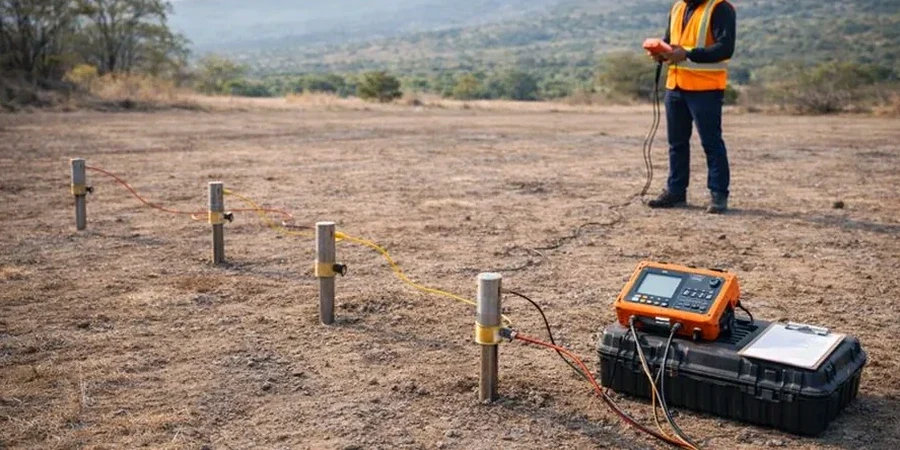
Cheltenham’s expansion from a Regency spa town into a modern residential and commercial hub has pushed development onto geologically complex margins. The town sits where the Severn Vale meets the Cotswold escarpment, and the transition zone packs in spring lines, variable drift deposits, and solution features within the limestone bedrock. Electrical resistivity surveying excels in this setting. By injecting a controlled current into the ground and measuring potential difference, we map vertical and lateral resistivity contrasts that correspond to changes in lithology, moisture content, and pore water chemistry. Clay-rich Lias formations read low resistivity, while dry oolitic limestone reads high. Sand and gravel layers fall somewhere in between. A properly executed VES profile, interpreted alongside a seismic refraction survey, can even flag karstic voids before they become a piling headache. Our field crews use multi-electrode systems with Wenner and Schlumberger arrays, selecting the configuration to match target depth and required resolution. Data processing runs through solid inversion software, and final sections are calibrated against existing borehole logs from the British Geological Survey archive, which holds extensive records for the Cheltenham district.
Electrical Resistivity Testing (VES) in Cheltenham
Technical reference — Cheltenham

Site-specific factors

The kit itself is straightforward: a ruggedised resistivity meter, a set of stainless steel electrodes, and multicore cable reels. The real risk lies in the interpretation, especially on Cheltenham’s brownfield sites. Made ground, buried services, and stray earth currents from nearby infrastructure can distort the apparent resistivity readings and produce artefacts in the inverted model. We have seen a leaking water main on a site near the Cheltenham Racecourse mimic a low-resistivity clay band at depth, which could have been misread as a weak layer. Our team cross-references every resistivity anomaly with available utility plans, historical maps, and physical trial pitting where access allows. The BS 5930 code of practice provides a solid framework, but experience on the local geology is what separates a reliable resistivity model from a misleading one. We also run reciprocal measurements and repeatability checks on at least 10% of data points to quantify error margins before delivering the final section.

Need a geotechnical assessment?

Reply within 24h.

Email: contact@geotechnical-engineering1.com

Applicable standards

BS 5930:2015 + A1:2020 — Code of practice for ground investigations, Eurocode 7 — Geotechnical design (BS EN 1997-1:2004 + A1:2013 and BS EN 1997-2:2007), BS 1377 — Methods of test for soils for civil engineering purposes (correlation context)

Typical values

ParameterTypical value
Array configurationsWenner, Schlumberger, Dipole-Dipole
Typical investigation depth2 to 120 metres below ground level
Electrode spacing range1 m to 50 m per spread
Data acquisition systemMulti-electrode resistivity meter, automatic switching
Applicable standardBS 5930:2015 + A1:2020
Output deliverables2D resistivity tomograms, pseudo-sections, depth slices
Typical survey line length40 to 400 metres per profile

Frequently asked questions

How much does an electrical resistivity survey cost on a typical Cheltenham residential plot?

For a standard residential site in Cheltenham, a VES survey with several sounding points or a short 2D profile generally falls between £480 and £880. The final figure depends on the number of soundings, the array configuration needed to reach target depth, and site access conditions. We provide a fixed quotation after reviewing the site location and the specific information the foundation designer requires.

How deep can a VES survey investigate in the Cotswold limestone?

A single VES sounding can probe from near-surface down to approximately 120 metres, though practical resolution diminishes with depth. In Cheltenham's geological setting, we typically configure arrays to focus on the upper 20 to 40 metres, which covers the critical zone of weathered limestone, clay bands, and potential solution features relevant to most foundation and earthworks projects.

Can resistivity testing locate voids and dissolution features in the limestone?

Yes, electrical resistivity is one of the primary geophysical methods for detecting air-filled or clay-filled cavities within limestone bedrock. A void typically appears as a high-resistivity anomaly surrounded by more conductive rock. However, the method requires careful interpretation; a dry, fractured zone can produce a similar signature. We calibrate resistivity anomalies against borehole data wherever possible to distinguish true karstic features from other geological variations.

What is the difference between VES and ERT, and which one do I need for a foundation design in Cheltenham?

VES gives you resistivity variation with depth at a single point, which works well when ground conditions are expected to be horizontally layered. ERT provides a continuous 2D cross-section along a survey line, capturing lateral changes. For foundation design in Cheltenham, where the clay-limestone interface can undulate significantly, we often recommend at least two intersecting ERT lines across the building footprint to map rockhead topography, supplemented by one or two boreholes for calibration.

Location and service area

We serve projects in Cheltenham and surrounding areas.

View larger map